
From Operator to Orchestrator: My AI Employees Don't Sleep
or... do they?

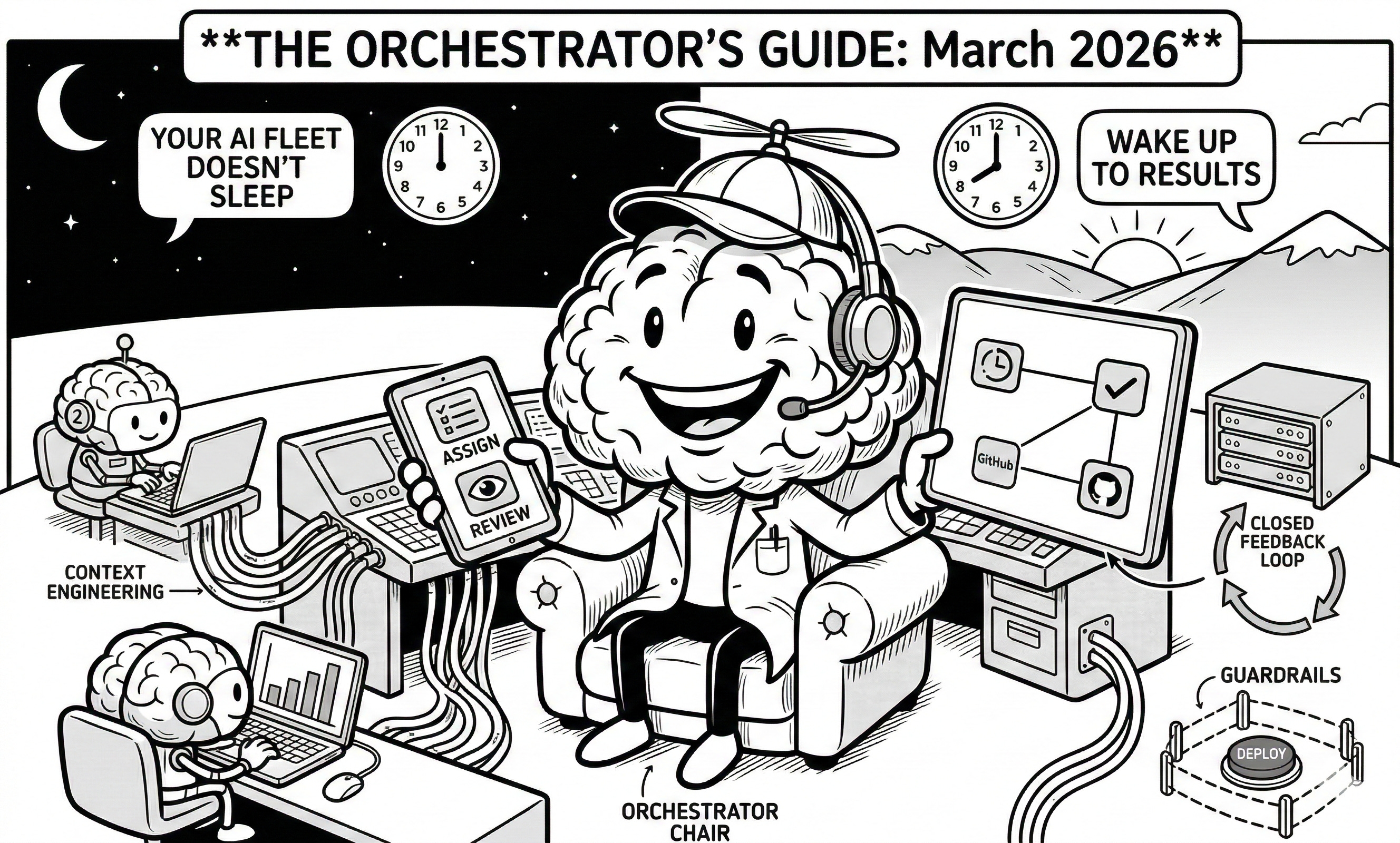
💡 Editor’s Note: Last month, we talked about giving agents hands. This month: what happens when you actually staff up and let your AI workforce run overnight. But before that, let’s take a look at AI events in East Coast!
📅 March 2026 NYC AI Events
🤖 Application
Mar 9: AgentCon New York - Full-day conference on AI agent design, deployment, and integration. Hands-on workshops + live demos. Global AI Community + Microsoft @ Nasdaq, Times Square. Free. Registration closes Mar 6. RSVP
Mar 13: Pace Actionable AI Conference - “Less Hype. More How.” Panels on AI as economic infrastructure, scaling adoption, navigating risks. Speakers from Google, Morgan Stanley, NYU, Zoom. Pace University NYC. Free. RSVP
Mar 24–26: AI for Communications Conference - Integrating AI into communication strategy — engagement, messaging, responsible adoption. Speakers from Comcast, Verizon, Kraft Heinz. NYC. Paid (group rate $199). RSVP
🛠️ Deep Dives
Mar 2, 4–7:30PM: Generative Media Meetup @ Bria AI Loft - Generative video and image tech — real-world applications, market trends. Speakers from Bria AI, DepositPhotos, Lightricks. 315 W 35th St. Free. RSVP
Mar 5, 11:30AM: Scaling RL Rollouts: Agent-Native Infrastructure with Daytona - Ivan Burazin (Daytona CEO) on orchestrating isolated sandbox environments at scale for RL and agentic workflows. Davis Auditorium. Columbia associates only.
Mar 19, 11:00AM: AI Attacks - Dr. Neil Daswani (Firebolt Ventures) on AI-orchestrated espionage campaigns and deepfake security threats. Davis Auditorium. Columbia associates only.
Mar 23–24: Xcelerated Compute Show + DCD>Connect NYC - North America’s largest data center + AI infrastructure conference. 4,500+ delegates, 232 speakers. Marriott Marquis, Times Square. Free for qualified technical attendees. RSVP
🎭 IRL
Mar 24, 6–9PM: AI Founders Supper Club - Curated dinner for 15–20 early-stage AI founders. Hosted by The AI Furnace (20K+ AI founder community). Midtown South. Free, invite-only. RSVP
Bottom Line
I stopped coding. I started managing AI agents like employees. My workflow went from “sit at laptop, pretend to be productive” to “define tasks before bed, review results over coffee.” In the past month I shipped more than my entire 2025 — not because I worked harder, but because I learned to delegate. And you don’t need my setup to start. You can do a version of this tonight with Claude Cowork and a folder on your desktop.
What Happened
A few months ago, I was stuck in the same loop most of us are in. Claude Code on my laptop. Cursor open. SSH-ing into EC2 from my couch. It worked, but it only worked when I was physically there, personally babysitting every session. That’s not an AI workforce. That’s autocomplete with extra steps.
So I built my way out. Four layers, each one solving a problem the previous one exposed:
GitHub orchestrator — agents receive work through GitHub issues, execute in parallel, submit PRs. I assign tasks from my phone while walking down the street.
Agent Hub — remote control for agent sessions across my fleet. Restart, reload, configure — none of this exists out of the box from any provider today.
Legion — multi-agent orchestration at scale. Each agent works in its own isolated context window, so they don’t contaminate each other’s memory or drift off task.
Fleet of dedicated machines — physical laptops (and yes, mac mini) with browser access, because agents need to actually see what they deploy. Preview the page. Check the console logs. Inspect network traffic.
That last one matters more than it sounds. There’s a concept in agentic engineering called the closed feedback loop — every agent failure traces back to a broken one. If your agent can’t perceive its own output, it can’t self-correct. The machine fleet closes that loop. It’s the difference between “generate code and hope” and “generate, deploy, verify, fix.”
I know — this sounds like overkill. It is, for most people. But the real payoff wasn’t the infrastructure. It was what the infrastructure made possible.
The Shift
Here’s when it clicked.
Before all this, my evening routine was: open laptop, kick off some Claude sessions, context-switch for an hour, close laptop, feel productive. Classic.
Now? Before I go to sleep, I write down what needs to happen tomorrow. I break it into tasks. I assign those tasks to my agents. I go to bed.
I wake up to completed work.
That sounds small. It’s not. It rewired how I think about everything. I’m no longer asking “how much can I work tonight?” I’m asking “what do I need my team to deliver by morning?”
I stopped thinking about code. I started thinking about:
What are we building and why?
What does done look like?
What deliverables do I expect?
How do the pieces connect?
How do agents report back?
That’s not engineering. That’s management. The same skills that make a good engineering manager — clear specs, tight delegation, rigorous review — are the exact skills that make someone effective with AI agents. In agentic engineering, this is the shift from process certainty (controlling every step) to outcome certainty (defining what success looks like and letting agents find the path). And underneath all of it is context engineering — the broader discipline of shaping everything your agent sees, knows, and remembers so it can actually deliver. Specs are part of it. So is memory, tool access, prior conversation, project structure. The quality of what your agents produce is a direct function of the context you give them.
A Real Example (And What Went Wrong)
My family’s finances were a mess of Google Sheets — one for expenses, one for investments, one for net worth, all manually maintained. Every time I sat down to update them, it was three to four hours of tedium.
Here’s what I did instead: I gave Legion nine features to build in parallel for a personal finance app. Agents implemented features, ran tests, submitted PRs, merged into main. I asked one last agent to do a sweep for gaps, set up auth, and deploy to a domain. Total hands-on time from me: minutes of spec-writing.
Then I gave agents access to my bank statements, investment account screenshots, and my Investment Policy Statement. Overnight, they crunched my full asset allocation, analyzed positions against my IPS, generated reallocation suggestions with visual breakdowns, and updated my database. I woke up to a financial review that would’ve taken me half a day.
But here’s the honest part. Agents built about 90% of the app beautifully. The last 10% — an auth edge case, a tricky visualization bug — needed me. The financial analysis was solid, but the actual fund transfers? That’s me, by hand, always. That’s by design. Let AI crunch, analyze, and recommend. Keep the irreversible stuff in your own hands.
A Quick Word on Guardrails
Yes, I gave agents access to my bank statements. Common sense still applies: tell your agents what they’re allowed to do and — more importantly — what they’re not. In your instructions, be explicit: no deleting files outside this directory, no making purchases, no sending emails without my approval. Limit the scope of what the agent can touch so that even if it goes sideways, the blast radius is small. Read-only access where possible. Keep irreversible actions — moving money, deploying to production, sending messages to real people — in your hands, not the agent’s. That’s it. You don’t need a security framework. You need common sense boundaries and a small sandbox. We’ll go deeper on this when most people are actually using agents — for now, just don’t hand over the keys to the whole house.
Start Here: Your First AI Night Shift
Everything above took months to build. You don’t need months. You need thirty minutes.
Option 1: Claude Cowork + Your Desktop (5 minutes)
Download Claude Cowork. Point it at a folder where your actual work lives — Desktop, Documents, a project directory. Give it a real task with a real deliverable:
“Go through ~/Documents/receipts/. Create a CSV with date, vendor, amount, and category for each receipt.”
“Read this project directory. Write a README describing the structure, what each file does, and how to run it.”
“Here’s my resume.pdf. Rewrite it for [specific role]. Save the new version next to the original.”
Level it up with MCP. Claude Cowork supports Model Context Protocol — USB ports for your AI agent. Connect filesystem, browser, Google Drive, GitHub, Notion. Now your agent can go from “work with files in this folder” to “research a topic across three websites, pull data into a Sheet, and draft a summary in Notion.”
Option 2: The Sunday Night Voice Dump (10 minutes)
Open your phone’s voice recorder. Talk for 3-5 minutes about what you need done this week. Don’t filter — just brain-dump. Send the recording to Claude or ChatGPT:
“Transcribe this. Break it into a prioritized task list. For each task, tell me: can an AI agent do this, or do I need to? For the AI-doable ones, write me the exact prompt to delegate it.”
Pick two tasks. Delegate them before bed. Review in the morning.
This works because voice produces richer context than typing. You naturally include the details, priorities, and constraints that feel “too much effort” to type out. A 3-minute voice dump carries more signal than most people pack into a 30-minute written prompt. In fact — this entire article started as a voice memo I recorded while walking. My agents transcribed it, structured it, and drafted from the recording. That’s how much of my workflow runs through voice now.
Option 3: GitHub as Your Task Board (15 minutes, for developers)
Create a private repo. Create issues with clear acceptance criteria. Connect Claude Code or Cursor to the repo. Tell the agent: “Look at issue #3. Implement it. Create a PR when done.”
After a week, you have a repo full of completed PRs. After a month, you feel the shift. You’re not writing code anymore. You’re reviewing it.
Option 4: The Full Overnight Loop (30 minutes, for technical people)
Spin up a small EC2 (t3.medium, ~$30/month). Install Claude Code. Start a tmux session. Clone your repo. Give the agent a task and a definition of done. Detach. Go to sleep. SSH back in the morning and read the results.
No custom platforms. No hardware fleet. Just a cloud VM, tmux, and a clear task description.
Start with option 1 tonight. Graduate to option 4 by next week. The mentality shift starts the moment you delegate your first real task and walk away.
Where We Stand
The ground is moving fast. As recently as October 2025, Karpathy dismissed agent hype as premature. By February 2026, he’d flipped entirely — going from 80% manual coding to 80% agent coding in under three months. His words: “You’re not typing computer code into an editor like the way things were since computers were invented. That era is over.”
Andrew Ng at Davos 2026 put it more bluntly: “A person that uses AI will be so much more productive, they will replace someone that doesn’t use AI.” But he also noted that AI currently handles only 30-40% of most jobs — the remaining 60-70% still needs you.
The enterprise numbers tell the same story from a different angle. 91% of enterprises now use AI coding tools in production. 57% are running multi-step agent workflows. Gartner predicts 40% of enterprise apps will have task-specific agents by year’s end — up from less than 5% in 2025.
And yet — PwC’s 2026 Global CEO Survey found 56% of CEOs reported neither increased revenue nor reduced costs from AI in the past twelve months. The tools are everywhere. The results aren’t — yet.
That’s the gap. Not between people who have AI and people who don’t. Between people who’ve made the mentality shift and people who are still using agents like a search bar.
Now What
Here’s why this should matter to you personally.
Every tool in this article is available right now. Claude Cowork is free to download. Claude Code runs on a $30/month VM. GitHub issues cost nothing. The infrastructure isn’t the barrier — the habit is.
The people who figure out agent delegation in 2026 aren’t going to have a marginal advantage. They’re going to operate at a fundamentally different scale. Ng said it plainly — the person using AI won’t just be faster than the person who doesn’t. They’ll replace them. Not because AI does your job. Because it lets you do the job of three people while sleeping through a third of it.
You don’t need my stack. You don’t need a fleet of laptops. You need one evening where you define a real task, hand it to an agent, and go to bed. That’s the first rep. Everything else compounds from there.
Your AI employees don’t sleep. The question is whether you’re giving them anything to do while you do.
What’s Coming Up
Community: Pioneering Minds AI community — peer connections, project sharing, mentored challenges. Join us.
Next month: What goes wrong when agents work unsupervised. Failure modes, recovery patterns, and how to build trust with your AI workforce incrementally. The manager’s guide to agent performance reviews.
References
Karpathy: Programming is “unrecognizable” — From 80% manual to 80% agent coding in three months
Andrew Ng at Davos 2026 — “A person that uses AI will replace someone that doesn’t”
2026 State of AI Agents Report — 91% enterprise adoption, 57% running multi-step agent workflows
Gartner: 40% of enterprise apps will embed agents by end of 2026
Agentic Engineering Knowledge Map — 54-article synthesis on agentic patterns and architectures
Context Engineering — The discipline of shaping what your agent sees, knows, and remembers
Model Context Protocol — MCP: “USB-C for AI agents”
Agents With Hands — Last month’s piece on agent capabilities